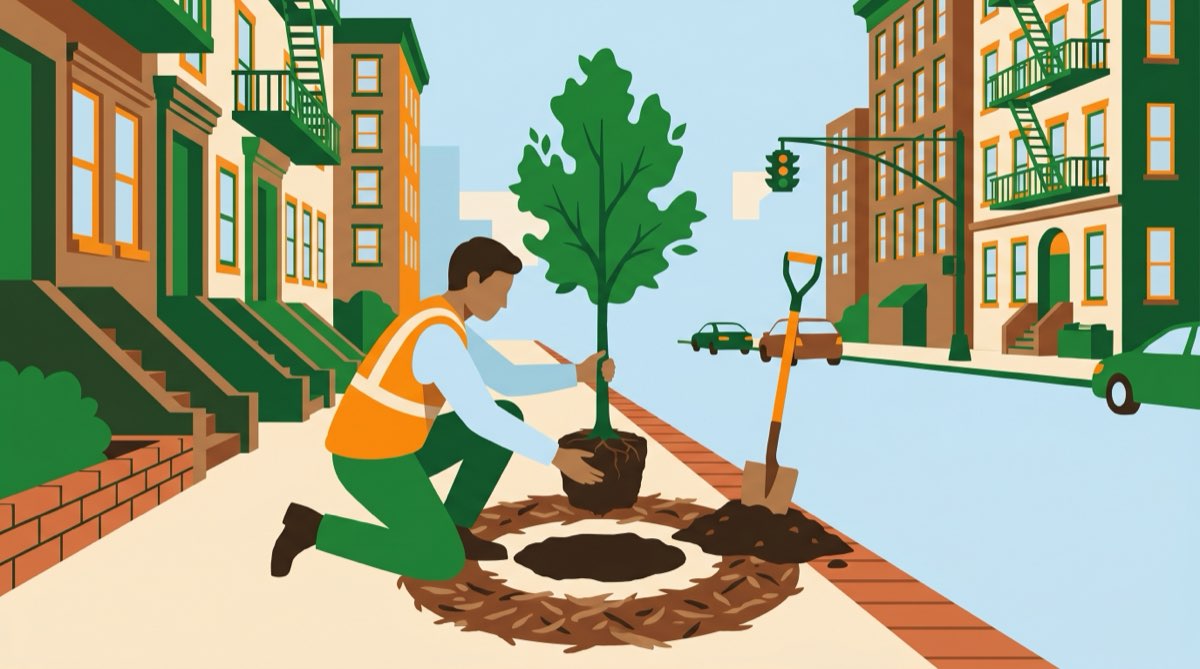
Learning how to plant a tree properly is one of the most impactful things a homeowner can do for their property, their neighborhood, and the environment. A well-planted tree increases curb appeal, lowers cooling costs, absorbs storm water, and can raise your home's value by up to 15 percent. But planting the wrong way - too deep, in poor soil, or without adequate water - can kill a tree in months.
In Brooklyn, Queens, and across New York City, urban conditions make tree planting even more challenging. Compacted soil, limited root space, sidewalk vaults, and overhead wires all affect how and where you should plant. This guide walks you through every step, from choosing the right species to long-term care, specifically for NYC homeowners.
Step 1: Choose the Right Tree for Your Space
Before you dig, select a tree that matches your site conditions. NYC's Parks Department recommends following the 10-20-30 rule: no more than 10% of one species, 20% of one genus, or 30% of one family in your landscape. This diversity protects against pests and diseases.
Consider These Factors
- Available space: Measure both above and below ground. Overhead wires, building setbacks, and underground utilities all limit your options. A tree that grows 60 feet wide does not belong under power lines. If you want quick shade, check our guide on the fastest-growing trees for NYC yards.
- Soil type: NYC soil tends to be compacted clay, sandy fill, or a mix. Test your drainage by digging a 12-inch hole and filling it with water. If it drains in less than an hour, you have sandy soil. If it takes 12+ hours, you have clay.
- Sunlight: Most trees need 6+ hours of direct sun. Shade-tolerant species like redbud or serviceberry can handle partial shade common between brownstones.
- Water access: Newly planted trees need regular watering. If you have no spigot nearby, choose a drought-tolerant species once established, or plan to haul water.
Step 2: When to Plant a Tree
Timing matters. The best time to plant is during dormancy - when buds are not opening and the tree is not actively growing. In NYC, that gives you two windows:
- Fall (late September through November): The best window. Soil is still warm from summer, encouraging root growth. Cool air reduces transplant shock. Roots have 6-8 weeks to establish before ground freezes.
- Late winter/early spring (March through April): The second-best window. Plant before buds opening, and water consistently through summer. Avoid planting during hot summer months - heat stress kills newly planted trees.
Step 3: Prepare the Planting Hole
The planting hole is where most mistakes happen. Here is how to get it right:
- Locate utilities first: Call 811 or visit call811.com before you dig. Underground gas, water, and electric lines run beneath many NYC properties. It is free and required by law.
- Measure the root ball: Before digging, measure the root ball height and width. Your hole should be 2-3 times wider than the root ball but no deeper than the root ball itself.
- Dig wide, not deep: A wide hole gives roots room to spread into native soil. A deep hole causes the tree to settle and sink below grade - the number one killer of newly planted trees.
- Rough up the sides: In NYC's compacted urban soil, smooth hole walls create a "bathtub effect" where water pools at the bottom. Score the sides with your shovel to break up glazing.
Step 4: Handle the Root Ball Correctly
How you handle tree roots before planting directly affects whether your tree survives. Different tree types require different handling:
Container-Grown Trees
Remove the container by cutting it away - never pull the tree by its trunk. Check for circling roots that wrap around the root ball. Cut any that circle more than halfway around the container. If the root mass is dense and circling heavily, make 4-6 vertical cuts through the root ball to encourage outward growth. Circling roots that are not corrected will eventually girdle and kill the tree.
Balled-and-Burlapped (B&B) Trees
Place the root ball in the hole first, then remove the wire basket, nails, and burlap from the top third of the ball. Pull burlap down the sides - do not fold it under the ball. Cut all twine around the trunk flare. Leaving twine or wire wrapped around the trunk strangles the tree over time.
Bare Root Trees
Bare root trees have no soil around their roots. They are the easiest to inspect for problems and the lightest to handle. Keep roots moist by covering them with wet burlap or heeling them into soil until planting time. Spread roots outward in the hole - never fold or prune them to fit a too-small hole. Plant bare root trees in late winter/early spring before buds opening.
Step 5: Plant at the Right Depth
This is the single most critical step. The trunk flare must be visible at or slightly above ground level.
The trunk flare is the point where the trunk widens at the base and transitions to roots. On many nursery trees, soil is piled over the flare. Before planting, gently remove excess soil until you can see the flare. Planting too deep causes:
- Bark rot at the soil line
- Root suffocation from poor gas exchange
- Circling roots that never spread outward
- Slow decline over 3-10 years - often misdiagnosed as disease
In NYC, where soil is often compacted and poorly draining, planting slightly high (1-2 inches above grade) is almost always the right call.
Step 6: Backfill and Mulch
Fill the hole with the same soil you removed. Do not add compost, fertilizer, or potting soil to the backfill. Research consistently shows that amended backfill creates a "flower pot effect" where roots circle in the rich backfill instead of growing outward into native soil.
Backfill Steps
- Fill the hole halfway with native backfill soil
- Water gently to settle - do not tamp or stomp
- Fill the rest of the hole to ground level (or slightly above)
- Create a 3-inch berm of soil around the outer edge of the planting area to form a water-holding basin
Mulch Correctly
Apply a 2-3 inch layer of organic mulch in a ring around the tree. Keep mulch 3-4 inches away from the trunk - never pile mulch against the bark ("volcano mulching"). This causes rot, invites pests, and creates a habitat for rodents that gnaw bark. The mulch ring should extend at least to the drip line or 3 feet in diameter, whichever is larger.
Step 7: Water Your Newly Planted Tree
Water is the single most important factor in tree establishment. Here is the schedule:
- Weeks 1-2: Water deeply every 2-3 days. The root ball should stay moist but not soggy.
- Weeks 3-12: Water deeply once per week during normal weather. During hot, dry NYC summers, increase to twice per week.
- Year 1: Continue weekly watering through the first growing season. A slow trickle from a hose for 15-20 minutes provides deep, effective moisture.
- Year 2-3: Water during extended dry periods (2+ weeks without significant rainfall).
Step 8: Stake Only When Necessary
Most trees do not need staking. Wind movement actually strengthens trunk wood and encourages root growth. Stake only when:
- The tree is top-heavy and cannot stand on its own
- You are planting on a windy, exposed site
- The tree is in a high-traffic area where it might get bumped
Use two stakes on opposite sides, connected with wide, flat ties that allow some trunk movement. Remove stakes and ties after one growing season - leaving them longer can girdle the trunk.
Step 9: Ongoing Care and Maintenance
After planting, proper care keeps your tree healthy for decades:
- Pruning: Do not prune at planting except to remove broken or dead branches. Structural pruning begins in year 2-3. Hire an ISA Certified Arborist for anything beyond small branches.
- Fertilizing: Do not fertilize in the first year. Let roots establish. After year one, a slow-release organic fertilizer applied in early spring supports growth.
- Mulch refresh: Add a thin layer of mulch each spring, keeping it away from the trunk.
- Winter protection: Wrap young thin-barked trees in late fall to prevent sunscald and frost cracking. Remove wrap in spring.
- Inspection: Check monthly for signs of stress - wilting, yellowing leaves, bark damage, or pest infestation. Early intervention saves trees.
Common Tree Planting Mistakes to Avoid
Even experienced gardeners make these errors. Avoid them and your tree will thank you:
- Planting too deep: The #1 killer. If the trunk flare is buried, the tree will slowly decline. Always plant at or above grade.
- Leaving wire or burlap on the root ball: These materials constrict roots and never decompose fast enough. Remove from the top third of B&B root balls.
- Over-mulching: "Mulch volcanoes" against the trunk cause bark rot and pest problems. Keep mulch 3-4 inches from the bark.
- Under-watering or over-watering: Both kill roots. Check moisture by sticking your finger 2-3 inches into the root ball. If it is dry, water. If it is soggy, wait.
- Choosing the wrong species: A 60-foot oak under power lines becomes a liability. Match species to site conditions, especially in tight NYC spaces.
- Ignoring utilities: Always call 811 before digging. Hitting a gas line or electrical conduit is dangerous and expensive.
NYC-Specific Tree Planting Tips
Planting a tree in New York City comes with unique challenges. Here are tips specific to the five boroughs:
- Sidewalk tree pits: NYC street trees are planted in tree pits - cutouts in the sidewalk. Minimum pit size is 5x10 feet, but larger is always better. Expand the pit if possible to give roots more room.
- Soil compaction: Urban soil is extremely compacted. Break up the soil in a wide area around the pit, not just the planting hole. Consider vertical mulching - drilling 2-inch holes 12-18 inches deep and filling with gravel to improve drainage.
- Salt damage: Road salt in winter damages tree roots. Flush the soil with heavy watering in spring to leach salt. Choose salt-tolerant species like honeylocust and ginkgo for street plantings near roads.
- Permits: Planting a tree on NYC parkland or in a public right-of-way requires a permit from NYC Parks. Visit nycgovparks.org for applications. Planting on private property does not require a permit, but call 811 before you dig.
- Free trees: NYC Parks occasionally offers free trees through programs like Trees for Tomorrow. Check nycgovparks.org/trees for current availability.
When to Call a Professional
Planting a small sapling from a nursery is a satisfying DIY project. But for larger trees, difficult sites, or questions about existing trees, professional help is worth the investment. Contact a certified arborist when:
- Planting a tree larger than 2-inch caliper (trunk diameter)
- Dealing with compacted urban soil that needs professional amendment
- Planting near underground utilities, foundations, or overhead wires
- A newly planted tree shows signs of decline - wilting, leaf drop, or dieback
- You need emergency tree service after storm damage
Tarzan Tree Removal Service has been serving Brooklyn, Queens, Manhattan, the Bronx, and Staten Island since 2012. Our certified arborists can help with tree selection, planting, pruning, and removal. Call (347) 833-5862 for a free estimate.