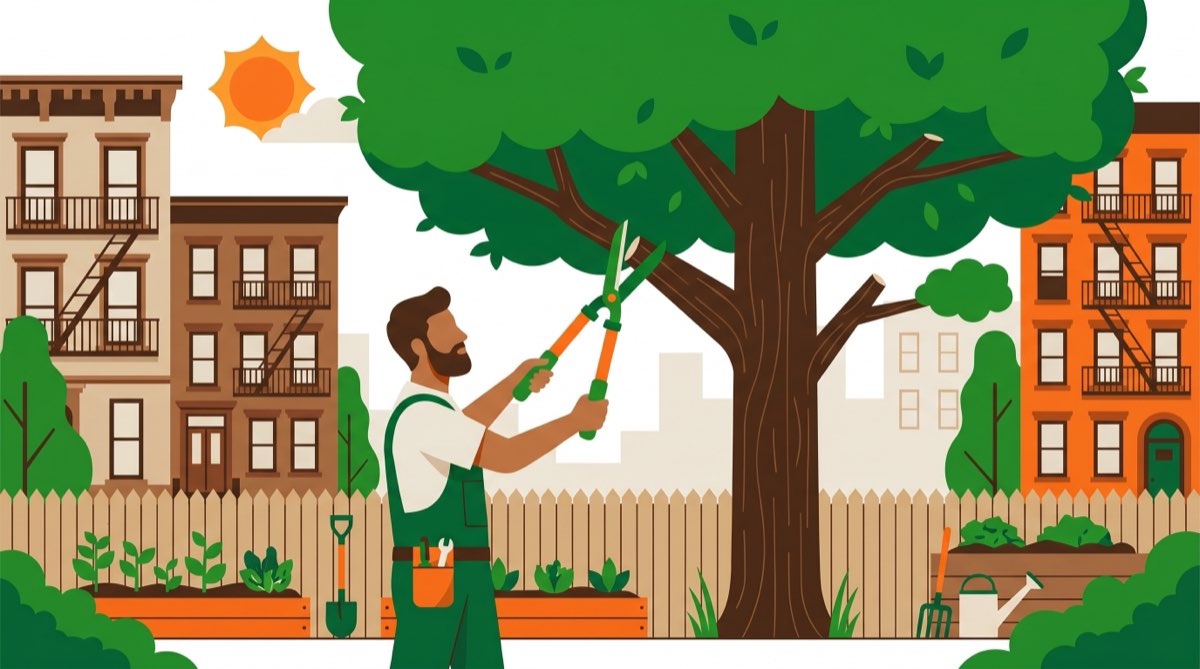
Learning how to prune a tree is essential for any NYC property owner who wants to keep their trees healthy and their property safe. If you need professional help, our tree pruning service covers Brooklyn and all five boroughs. Proper tree pruning removes dead or damaged branches, improves structure, and reduces risk - but improper pruning is worse than no pruning at all. In Brooklyn and across all five boroughs, where trees grow in tight spaces between buildings, sidewalks, and overhead wires, correct pruning technique matters more than ever.
This guide covers when to prune, which branches to cut, the tools you need, and the techniques that protect your tree's long-term health. Whether you are maintaining a backyard maple or managing a row of street trees, these principles apply.
When to Prune: Timing Matters
The timing of your pruning cuts directly affects how well the tree recovers. The general rule for deciduous trees in NYC: dormancy is the ideal window.
Late Winter Pruning (Best for Most Trees)
January through March, when trees are fully dormant, is the optimal pruning window. Without leaves, the structure is visible and you can see exactly which branches need work. Cuts made during dormancy heal quickly when spring growth begins, and there is lower risk of insect infestation or disease transmission.
Spring-Flowering Trees
Trees that bloom in early spring - dogwood, redbud, cherry, magnolia - should be pruned immediately after flowering. Pruning these in winter removes the flower buds and eliminates the spring display. For NYC ornamentals, this means pruning in late April through May.
What Not to Prune in Summer
Avoid heavy pruning during hot summer months. Heat-stressed trees cannot seal wounds efficiently, and open cuts attract borers and fungal pathogens. The one exception: dead branches can and should be removed any time, regardless of season.
The Tools You Need
Using the right tool for the branch size makes clean cuts that heal properly:
- Hand pruners (bypass): For branches up to ¾ inch diameter. Bypass pruners make a scissor-like clean cut. Avoid anvil pruners, which crush rather than cut.
- Loppers: For branches ¾ to 1½ inches. Long handles give leverage for clean cuts on medium branches.
- Pruning saw: For anything over 1½ inches. A curved folding saw is versatile and fits in a pocket. Use pulling strokes - the saw cuts on the pull stroke.
- Pole pruner: For high branches you cannot safely reach from the ground. Use on branches up to 1½ inches at heights under 15 feet.
How to Make the Cut
Where and how you make each cut determines whether the tree heals or decays. There are two critical anatomy points to understand:
- Branch collar: The swollen area where the branch meets the trunk. This tissue contains specialized cells that grow over pruning wounds. Cut just outside the collar - never into it.
- Branch bark ridge: The raised line of bark where the branch meets the trunk on the upper side. Your final cut should be just outside this ridge, angled away from the trunk.
The most common practice among professional arborists is to position the cut just outside the branch collar, at a slight angle that mirrors the bark ridge. This natural angle allows the tree to seal the wound efficiently.
Removing Large Branches: The Three-Cut Method
Large branches require a specific technique to prevent the weight of the branch from tearing bark down the trunk. This is the three-cut method - it is non-negotiable for any branch over 2 inches in diameter:
- Make an undercut - 6 to 12 inches from the trunk, cut upward one-third through the branch. This prevents bark from stripping when the branch falls.
- Remove the branch - From above, cut just outside the undercut. The branch falls away cleanly, its weight held by the undercut rather than the bark.
- Cut the stub - Make your final cut just outside the branch collar, removing the remaining stub. The cut should be clean, with no ragged edges.
What to Prune: Target Branches
Not every branch needs to come off. Focus on these categories:
Dead and Damaged Branches
Remove dead, broken, or diseased branches first. Dead wood does not heal and provides entry points for decay organisms. Snap a small twig - if it is brittle and snaps cleanly with no green beneath the bark, it is dead.
Crossing and Rubbing Branches
When two branches cross and rub against each other, they create wounds. Remove branches that are growing toward the center of the canopy or crossing others. Keep the branch with the stronger, more desirable angle.
Sucker Shoots
Sucker shoots grow straight up from the rootstock below the graft union (common on grafted trees like ornamental cherries and crabapples). They drain energy from the tree and never develop into desirable branches. Cut them at the base, flush with the trunk or root.
Water Sprouts
Water sprouts are vigorous, vertical shoots that grow from previously pruned or damaged branches. They are structurally weak, grow rapidly, and shade out healthy lateral growth. Remove them at the base, cutting just outside the branch collar.
Pruning Techniques by Goal
Crown Cleaning
Crown cleaning is the removal of dead, diseased, and broken branches from the canopy. This is the safest and most common form of pruning. It does not reduce the tree's size or change its shape - it simply removes hazards. Every tree benefits from crown cleaning annually or every two years.
Crown Thinning
Crown thinning selectively removes live branches throughout the canopy to improve light penetration and air circulation. The goal is to reduce the density without changing the tree's natural shape. Remove branches that cross, grow inward, or compete with the leader. Never remove more than 25% of live canopy in one season.
Thinning is especially important for dense shade trees like lindens and maples in Brooklyn, where thick canopies block airflow and increase the risk of fungal disease. Proper thinning also reduces wind resistance, which helps large urban trees withstand Nor'easters and summer thunderstorms.
Crown Reduction
Crown reduction decreases the overall height or spread of the tree by cutting pruning branches back to a lateral branch that is at least one-third the diameter of the removed branch. This is the correct way to reduce a tree's size - and it is very different from topping.
Common Pruning Mistakes to Avoid
- Topping: Cutting the main leader to a stub destroys tree structure and health. Use crown reduction instead.
- Flush cutting: Cutting into the branch collar prevents the tree from sealing the wound. Always cut just outside the collar.
- Over-pruning: Removing more than 25% of live canopy triggers stress. Spread heavy pruning over multiple years.
- Leaving stubs: A stub prevents wound closure and becomes an entry point for decay. Cut at the branch collar.
- Using wound paint: Research shows sealers trap moisture and slow healing. Trees compartmentalize wounds naturally - let them do it.
- Pruning at the wrong time: Heavy pruning during summer heat or fall fungus season increases disease risk. Stick to late winter for most species.
NYC-Specific Pruning Considerations
New York City's urban forest faces unique challenges. Here are pruning considerations specific to the five boroughs:
- Street tree regulations: NYC Parks requires a permit for any pruning of street trees (those in the public right-of-way). Only licensed tree care companies can perform work on them. Fines for unauthorized pruning range from $500 to $5,000 per tree. Visit nycgovparks.org for permits.
- Aerial wires: Never prune within 10 feet of power lines. Con Edison handles all utility line clearance in NYC. If branches are near lines, call 311 or Con Edison - do not attempt the work yourself.
- Sidewalk damage: Tree roots lifting sidewalks are a common NYC issue. Root pruning requires a permit and should only be done by a certified arborist to avoid destabilizing the tree.
- Sidewalk tree pits: When pruning street trees, do not pile branches in the tree pit. Debris compacts soil and blocks water infiltration.
- Storm cleanup: After severe weather, prioritize removing hanging branches (widow-makers) that could fall. Call our 24-hour emergency tree service for immediate assistance.
When to Hire a Professional Arborist
Many pruning tasks are safe for homeowners with the right tools and knowledge. But some situations require professional equipment and expertise. For budgeting, see our tree trimming cost guide for Brooklyn homeowners.
- Any branch over 6 inches in diameter
- Any work that requires a ladder or reaching above head height
- Branches within 10 feet of power lines
- Large trees near buildings, vehicles, or pedestrian areas
- Crown reduction on mature trees
- Storm-damaged trees with hanging or split branches
Tarzan Tree Removal Service employs ISA Certified Arborists who understand NYC's tree regulations and urban growing conditions. We handle everything from routine pruning to complex removals. Call (347) 833-5862 for a free estimate.