
In New York City, trees and wires share the same tight airspace brownstone blocks, narrow driveways, backyards with service drops, and sidewalks lined with street trees. When branches get close (or start touching), near power lines tree removal becomes a safety job first and a tree job second. If you need an NYC crew that’s licensed, insured, and built for high-stakes removals, start here: https://tarzantreeremovalservice.com/.
Below is the no drama playbook: what’s dangerous, who to call, how professionals control risk, and the smartest next steps for homeowners and property managers across Brooklyn, Queens, Manhattan, the Bronx, and Staten Island.
Key Takeaways
- Most tree-trimming electrical fatalities involve overhead power lines (84%) this is not a DIY scenario. ESFI
- Assume every wire is energized until the utility confirms otherwise and keep people back. Con Edison+1
- In NYC, utility coordination may be required (especially for entangled lines or street trees). NYC Parks+1
- Storm damage + wires = treat it like an emergency and route correctly. Con Edison+1
- The safest removals are controlled dismantles: sectional cuts + rigging + exclusion zones not “just cutting it down.”
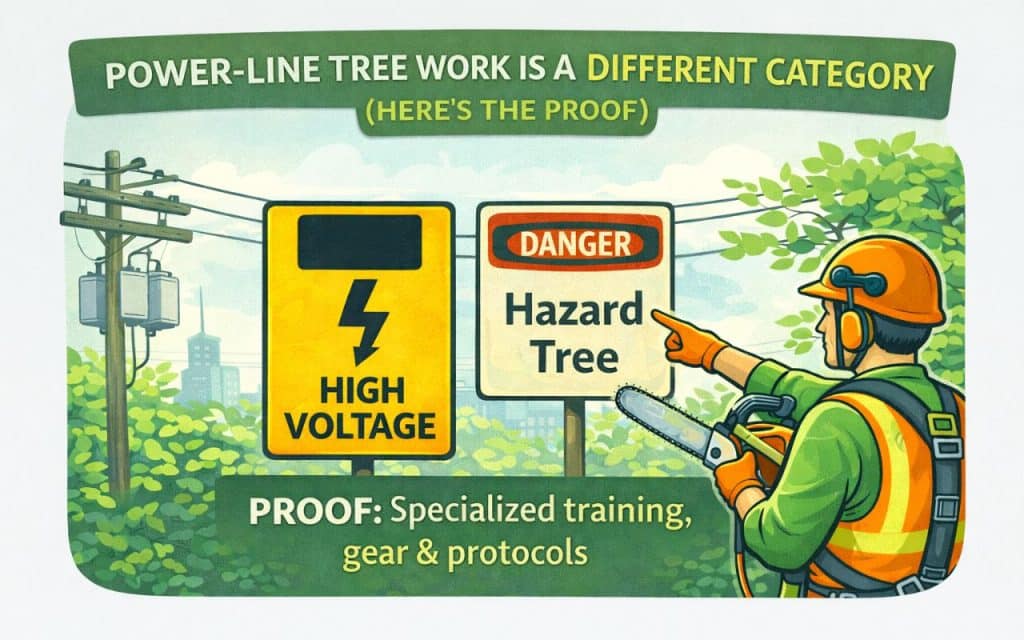
Power-line tree work is a different category (here’s the proof)
Tree work near energized lines isn’t “a little more risky.” It’s statistically one of the most dangerous setups in the trade.
- 84% of workplace electrical fatalities in tree trimming occurred when trimmers contacted overhead power lines. ESFI
- 70% of worker electrical fatalities happen in non-electrical occupations; people who aren’t electricians still get killed by electricity. ESFI
- Electrocutions represented 7% of all occupational fatalities tracked in a major NIOSH dataset (1980-89).
Safety Snapshot (Why Pros Only) | Near Power Lines Tree Removal
Power-line tree work is a high-voltage risk zone.
These are national safety stats used to educate property owners and managers. In NYC, the safest approach is controlled removal + utility coordination when needed.
Key Stats (in %)
- 84% – In tree trimming, most electrical fatalities involve contact with overhead power lines.
- 70% – Most workplace electrical fatalities happen in non-electrical occupations (people who aren’t electricians).
- 7% – Electrocutions represent 7% of total occupational fatalities in a major safety dataset.
NYC first: is it a power line… or a cable/phone line?
NYC has multiple wire types on poles. Some aren’t electrical (cable/telecom), but you should treat unknown lines as hazardous until confirmed.
Con Edison’s guidance separates scenarios: if it’s close to telephone or cable wires, you contact the provider; if it’s NYC tree issues not near wires, NYC Parks/311 is the route. Con Edison
Real-world rule: if you can’t confidently identify the line, don’t touch it, don’t cut near it, and don’t let anyone “check it out.”
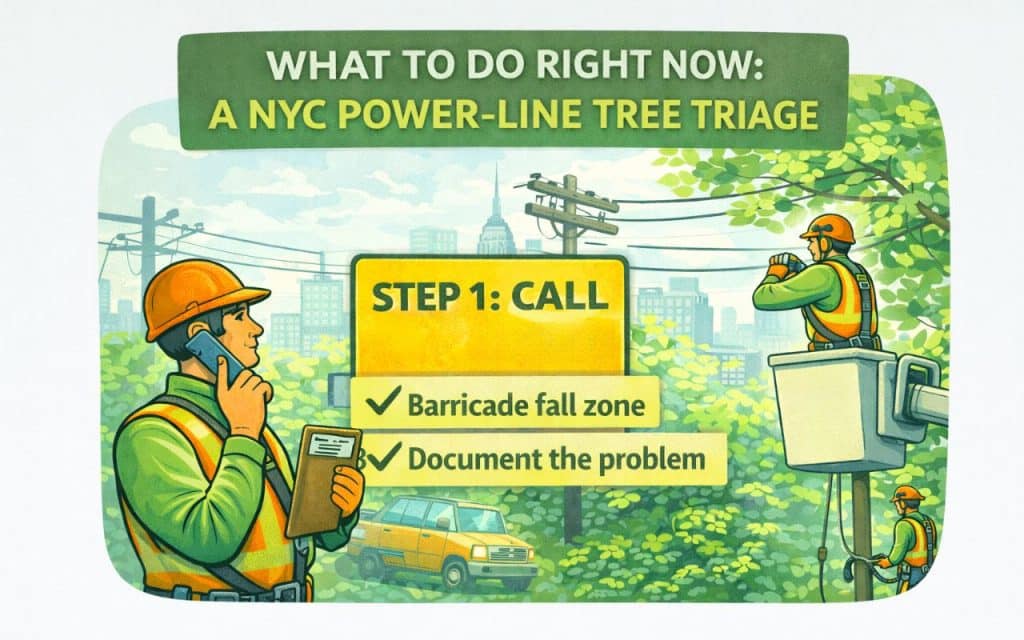
What to do right now: a NYC power-line tree triage
Use this when a tenant calls, your super texts you a photo, or you step outside and see branches in the wires.
1) If a line is down, sparking, or the tree is tangled in wires
- Back everyone up and treat it as energized.
- Call 911 for immediate danger and contact the utility (Con Edison). Con Edison’s own contact guidance says to keep distance and call 911 for downed lines. Con Edison
- NYC Parks specifically notes: if a tree is entangled in electrical wires, contact Con Edison’s Pruning Division (they list the number on their page). NYC Parks
- NYC311 also routes outdoor electrical system complaints (dangling/downed lines, hotspots) to Con Edison. NYC311
2) If branches are close but not touching schedule prevention
This is where proactive tree trimming near power lines stops outages and emergency calls. Con Edison trims trees to keep safe distances from overhead lines and prevent outages. Con Edison
For the actual pruning/removal on private property, your best next step is a licensed tree company with tight-space rigging experience:
- Tree trimming: https://tarzantreeremovalservice.com/tree-trimming/
- Tree removal service: https://tarzantreeremovalservice.com/tree-removal-service/
Common NYC scenarios (and the safest next move)
| NYC scenario | What it usually looks like | Best next move |
|---|---|---|
| Backyard service drop near the house | Branches over the wire feeding the building | Safest next move Schedule preventive trimming + controlled rigging
(no ladder + saw near lines) |
| Street tree limbs over distribution wires | Sidewalk canopy close to wires/pole hardware | Safest next move Route through NYC Parks/311 when applicable; utility coordination may apply (Con Edison1)
|
| Tree/limb in wires after storm | Hanging limb, tree leaning into lines | Safest next move Treat as energized; utility first; then emergency removal
|
| Tree fell and blocked access | Driveway/entry blocked, wires nearby | Safest next move Prioritize safety + access restoration; document for insurance
|
If a tree is already down (even without wires), this guide helps: https://tarzantreeremovalservice.com/fallen-tree-removal/
If you’re planning ahead before storms hit, use: https://tarzantreeremovalservice.com/how-to-prepare-your-yard-for-storm-season-in-nyc/
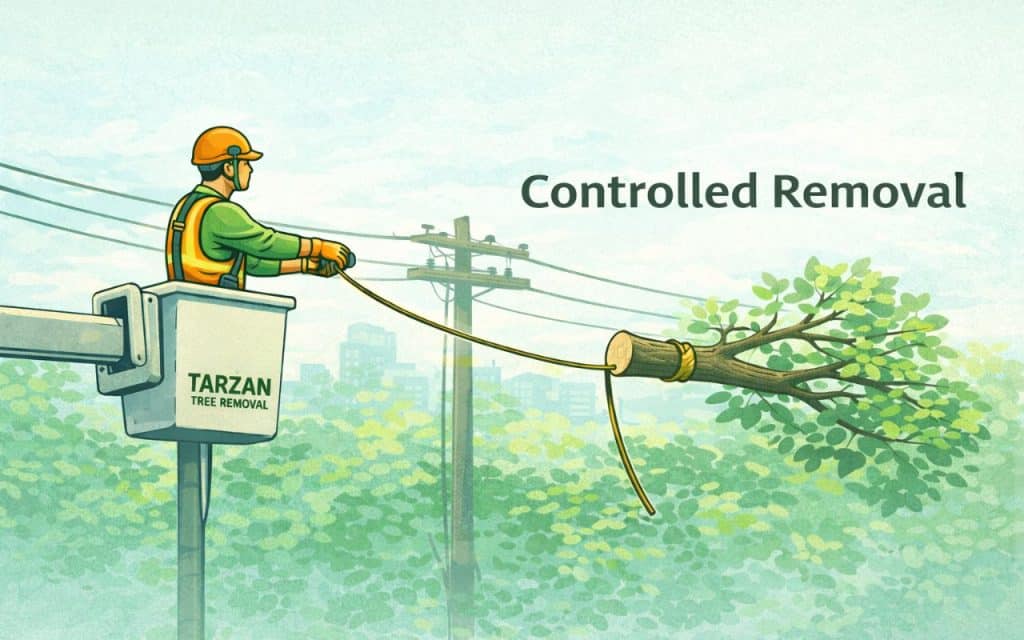
How professionals remove trees near power lines (the controlled method)
This is what “done right” looks like in NYC:
Step 1: Establish the exclusion zone (and keep it)
Con Edison’s contractor safety guide calls the 10-foot area around unprotected lines a danger zone, and emphasizes assuming lines are energized. Con Edison
That affects where crews place ropes, where pedestrians can walk, and whether a bucket/crane is even an option.
Step 2: Choose the right method (climb + rig, bucket, or crane)
- Climb + rigging for tight backyards and brownstone lots (controlled lowering piece by piece)
- Bucket truck when street access allows safe positioning
- Crane-assisted work only when the site allows compliant clearance and coordination
If a crane is used, OSHA has specific power line safety rules including clearance requirements (commonly referenced around 20 feet for certain operations unless deenergized/verified). OSHA
Step 3: Sectional dismantle (no “free-fall” pieces)
Near wires, pros reduce risk by:
- small, controlled cuts
- rigging that keeps wood from swinging into the line
- planned lowering zones
Step 4: Utility coordination when required
In NYC, the “right call” may include Con Edison involvement especially for entanglement or hazardous trees near overhead equipment. Con Edison publicly describes inspection/trimming programs and hazardous tree removal near power lines. Con Edison+1
Step 5: Clean finish: debris + stump plan
Leaving a stump in a tight NYC yard can be a trip hazard and a future headache. If you want the site truly reset:
- Stump removal: https://tarzantreeremovalservice.com/tree-stump-removal-near-me/
- Full list of offerings: https://tarzantreeremovalservice.com/services/
Table: Score the job (higher = more urgent + more complex) | Near Power Lines Tree Removal in NYC
| Factor | 0 pts | 2 pts | 4 pts |
|---|---|---|---|
| Line proximity | 10+ ft away | Within 10 ft | Touching / entangled |
| Tree condition | Healthy | Some deadwood | Split/leaning/hanging |
| Weather | Calm | Wind forecast | Storm damage present |
| Targets below | Low | Medium | High (public sidewalk/entrances/vehicles) |
| Access | Easy | Limited | Extremely tight |
- 0 – 6: planned trimming/removal
- 7 – 12: advanced rigging + likely utility coordination
- 13 – 20: urgent evaluation + emergency routing
Emergency Tree Removal
Cost drivers: why near power lines tree removal is priced differently
| Cost factor | Why it affects price | What it protects |
|---|---|---|
| Rigging + extra crew | Controlled lowering takes time | Lines, roofs, fences, pedestrians |
| Utility coordination | May require routing/clearance steps | Prevents outages and hazards |
| Tight access logistics | Small yards change everything | Keeps work controlled, not improvised |
| Storm damage complexity | Unstable wood behaves unpredictably | Prevents secondary failures |
| Cleanup + haul-away | NYC disposal + access challenges | Keeps site safe and clean |
FAQ
Who is responsible for trees over power lines?
It depends on whether it’s a city tree or private property and whether the issue is a utility electrical hazard. Con Edison describes its trimming programs to keep trees safely away from overhead lines, and NYC Parks directs electrical entanglement issues to Con Edison’s pruning division. Con Edison+1
Who do I call to trim trees around power lines in NYC?
If it’s electrical equipment or lines (dangling/downed lines, hotspots), NYC311 routes complaints to Con Edison, and Con Edison’s emergency guidance stresses keeping distance and calling 911 for downed lines. NYC311+1
For prevention on private property, use a professional tree service with controlled rigging.
After a storm, who removes debris?
Con Edison notes that trained crews remove trees/limbs that fall on overhead lines, but debris may be left, and if the tree was on your property you’re responsible for debris removal. Con Edison
How much will insurance pay for tree removal?
Insurance often covers removal when a tree hits an insured structure, but limits vary (commonly cited ranges like ~$500 – $1,000 depending on policy/insurer). The Insurance Information Institute outlines typical caps and when debris removal may not be covered. III+1
Next step (fast, NYC clean)
If you’re dealing with branches near wires or you manage a building and want a prevention plan handle it like NYC pros do: control the risk first, then remove the tree safely.
Start with:
- Tree trimming: https://tarzantreeremovalservice.com/tree-trimming/
- Tree removal: https://tarzantreeremovalservice.com/tree-removal-service/
- Emergency: https://tarzantreeremovalservice.com/tree-removal-emergency/
- Stumps: https://tarzantreeremovalservice.com/tree-stump-removal-near-me/
- All services: https://tarzantreeremovalservice.com/services/
